From Page to Stage, Smarter: How AI is Reshaping School & Community Theater Production
Discover how AI in theater production is transforming school and community groups. Learn to leverage smart tech to boost creativity, streamline tasks, and reduce stress.
· By CueCall Team
Topics: AI in theater, theater production technology, school theater, community theater, theater management, stage management, directing, production tools

You know the feeling, don't you? That exhilarating rush when a new script lands in your lap, brimming with potential. The vibrant characters, the intricate plot, the powerful messages waiting to be brought to life. For school and community theater directors, stage managers, and producers, this initial spark is what fuels countless hours of dedication. But then, reality sets in. The endless to-do lists, the volunteer wrangling, the budget tightropes, the late nights spent juggling spreadsheets and trying to conjure inspiration from thin air. What if there was a way to keep that initial spark burning brighter, longer, by offloading some of the relentless groundwork? What if the power of AI in theater production could actually become your secret weapon?
The Unseen Burdens: When Passion Meets Practicality
Your passion for theater is immense. It's why you dedicate evenings and weekends, why you pour your heart into transforming a group of dedicated volunteers into a cohesive, magical ensemble. But let's be honest: that passion often comes hand-in-hand with an overwhelming pile of practicalities that can sap your energy and dilute your focus on the artistic vision.
Think about the early stages of a production, long before the first rehearsal. You're not just casting; you're often acting as a researcher, a designer, a strategist, and a problem-solver all at once:
- The Blank Page Intimidation: Staring at a script and needing to envision an entire world – sets, costumes, lighting – from scratch. How do you find fresh inspiration without endless hours of deep-dive research?
- The Pre-Production Puzzle: Beyond casting, there's the monumental task of initial blocking concepts, understanding character arcs, identifying key thematic elements, and anticipating potential challenges in staging. How do you get a head start on these complex creative hurdles?
- The Information Overload: Sifting through historical references for a period piece, understanding dramaturgical nuances, or researching local vendors for specific props can be incredibly time-consuming, pulling you away from directorial choices.
- The Budget Balancing Act: Exploring different production design options and understanding their cost implications requires constant adjustments and 'what-if' scenarios. Every penny counts, especially for volunteer-driven groups.
- The Scheduling Scramble (Even Before it Begins): Crafting even a preliminary rehearsal schedule requires anticipating conflicts, understanding the flow of scenes, and mapping out character appearances. It’s a beast of a task that can stall momentum before it even starts.
These aren't just administrative tasks; they're creative burdens that often fall squarely on your shoulders, alongside everything else. For volunteer theater practitioners, who already wear multiple hats in their daily lives, these 'unseen' burdens can quickly lead to burnout, making the joy of creation feel more like a relentless chore.
Why It Matters: Preserving the Spark, Elevating the Art
Why should we care so deeply about alleviating these invisible pressures? Because the quality of your school or community theater production, and indeed the sustainability of your group, depends on it. When you're constantly fighting fires and feeling overwhelmed, several critical aspects suffer:
- Artistic Vision Compromised: When your energy is spent on mundane tasks, your capacity for truly innovative, thoughtful direction and stage management diminishes. You might settle for "good enough" instead of striving for "extraordinary" because you simply don't have the mental bandwidth.
- Volunteer Burnout: You're not the only one feeling the crunch. When the core leadership is stressed, it trickles down. Volunteers, who dedicate their precious free time, are more likely to get discouraged and disengage if the production process feels chaotic and inefficient. Recruiting and retaining talent becomes a constant uphill battle.
- Limited Growth & Ambition: With so much time dedicated to basic operational tasks, there's little room for growth, experimentation, or tackling more ambitious projects. Your group might feel stuck in a rut, unable to push creative boundaries because the logistical demands are too great.
- Reduced Quality of Experience: For everyone involved – cast, crew, and ultimately the audience – a smoother, more organized production process leads to a more positive and enriching experience. When things run well, confidence grows, creativity flows, and the final product shines brighter.
Ultimately, it’s about preserving that initial spark of theatrical passion. It's about empowering you to spend more time directing, inspiring, and connecting, and less time wrestling with the logistical dragons that threaten to consume your creative energy. This is where smart technology, and specifically AI, steps onto the stage.
The Curtain Rises on Smart Production: How AI Can Be Your Co-Pilot
Forget the dystopian sci-fi visions. In the context of school and community theater, AI isn't here to replace human creativity; it's here to augment it. Think of it as an incredibly intelligent, tireless assistant, capable of processing vast amounts of information and generating insights or drafts that would take you hours, if not days. It's about working smarter, not harder, so your most valuable resource – your human ingenuity – can truly shine.
AI for Creative Kickstarts & Research: Igniting Your Vision
Imagine having a brainstorming partner who knows every script inside and out, understands dramatic structure, and has access to a library of design concepts. AI can be that partner:
- Script Analysis & Dramaturgical Insights:
- Feed your script into an AI tool and get initial breakdowns of character arcs, key themes, potential staging challenges, and even suggestions for scene transitions.
- Receive summaries of historical or cultural contexts relevant to your play, saving you hours of research time for period pieces.
- Identify recurring motifs or symbols, helping you develop a cohesive artistic concept from the outset.
- Design Inspiration Generation:
- Input keywords – "Victorian street scene," "futuristic spaceship interior," "whimsical forest" – and generate mood boards, color palettes, or even basic conceptual sketches for sets, lighting, and costumes. This isn't final design, but a powerful starting point to spark your team's creativity.
- Explore different scenic materials or lighting techniques based on desired mood or budget constraints.
- Pre-Visualizing Blocking & Staging:
- While not a replacement for live rehearsal, some tools can help you sketch out initial blocking ideas based on character movement patterns or dramatic beats, offering visual references before you even step into the rehearsal room.
- Suggest solutions for challenging stage directions or complex crowd scenes, giving you a foundation to build upon.
AI for Streamlining Mundane, Time-Consuming Tasks: Reclaiming Your Time
The operational side of theater production, while essential, can be a monumental time sink. AI excels at automating and assisting with these repetitive, data-heavy tasks, freeing you up for higher-level thinking and creative problem-solving.

- Drafting Preliminary Schedules & Rehearsal Breakdowns:
- Based on your script, cast availability (if input), and desired rehearsal phases, AI can generate a foundational rehearsal schedule, complete with scene breakdowns and character call times. This provides a tangible starting point that you can then refine, rather than building from scratch.
- Automatically identify scenes with specific cast members, making it easier to plan efficient rehearsal blocks.
- Generating Initial Prop & Costume Lists:
- Beyond a simple search, AI can analyze your script for explicit and implied prop and costume needs, cross-referencing against character appearances and scene settings. It can even flag items that might require special sourcing or construction.
- For costume managers, AI can help categorize existing inventory against new production needs or suggest rental options.
- Budget Scenario Analysis & Cost Estimation:
- Input various design choices or material preferences, and AI can help model different budget scenarios, providing estimations for sets, props, costumes, and even labor. This allows for informed decision-making early on.
- Identify potential cost-saving opportunities or alert you to areas where expenses might exceed projections.
- Automated Report Generation:
- Need a quick report on scene progress, costume fitting statuses, or inventory usage? AI-powered tools can quickly compile and present this data, saving countless hours typically spent manually tracking and formatting.
Integrated Dashboards & Beyond: The Power of a Unified Platform
The true power of AI in theater production isn't just in individual tools, but in how these intelligent capabilities are integrated into a comprehensive production management platform. Imagine a central hub where:
- Your AI-generated script insights inform your scene blocking tool.
- Your AI-suggested costume designs are linked directly to your costume inventory and fitting schedule.
- Your preliminary AI-drafted schedules integrate seamlessly with actual cast availability and rehearsal room bookings.
This seamless flow of information, enhanced by AI, creates a holistic, dynamic ecosystem for your entire production. Role-based dashboards, for instance, become smarter, offering personalized insights and task suggestions based on their specific responsibilities and the overall production progress. Costume slideshows, often a chaotic collection of images, can be automatically tagged, categorized, and even cross-referenced with actor measurements by AI for ultimate efficiency.
Taking Action: Integrating Smart Tech into Your Theater's Workflow
The idea of embracing new technology, especially AI, might feel daunting for busy volunteer groups. But the transition doesn't have to be overwhelming. Here's how you can start to integrate smart production tools into your theater's workflow:
- Assess Your Biggest Pain Points: Where do you and your team feel the most stress and lose the most time? Is it early script analysis? Finding design inspiration? Initial scheduling? Identify 1-2 areas where AI assistance could make the most immediate impact.
- Research & Explore: Look for platforms that are specifically designed for theater production and clearly articulate their AI-powered features. Focus on tools that simplify, not complicate, your existing processes.
- Start Small, Integrate Gradually: You don't need to overhaul your entire system overnight. Pick one feature – perhaps AI-driven script breakdown for your next production – and see how it works. Get comfortable, gather feedback, and then expand.
- Embrace Augmentation, Not Replacement: Remind yourself and your team that AI is there to serve your creativity, not diminish it. It’s a powerful assistant, not a substitute for your artistic choices, directorial instincts, or the magic of human collaboration.
- Encourage Team Buy-In: Introduce these tools as a way to make everyone's lives easier and the production process more enjoyable. Highlight the benefits: less administrative work, more time for creative tasks, reduced stress, and ultimately, a higher quality show.
The landscape of theater production is evolving. While the core human element – the storytelling, the performance, the connection – remains timeless, the tools we use to bring those stories to life are becoming increasingly sophisticated. By intelligently leveraging AI in theater production, school and community groups have an unprecedented opportunity to elevate their craft, empower their volunteers, and truly make the stage a place of unburdened creativity.
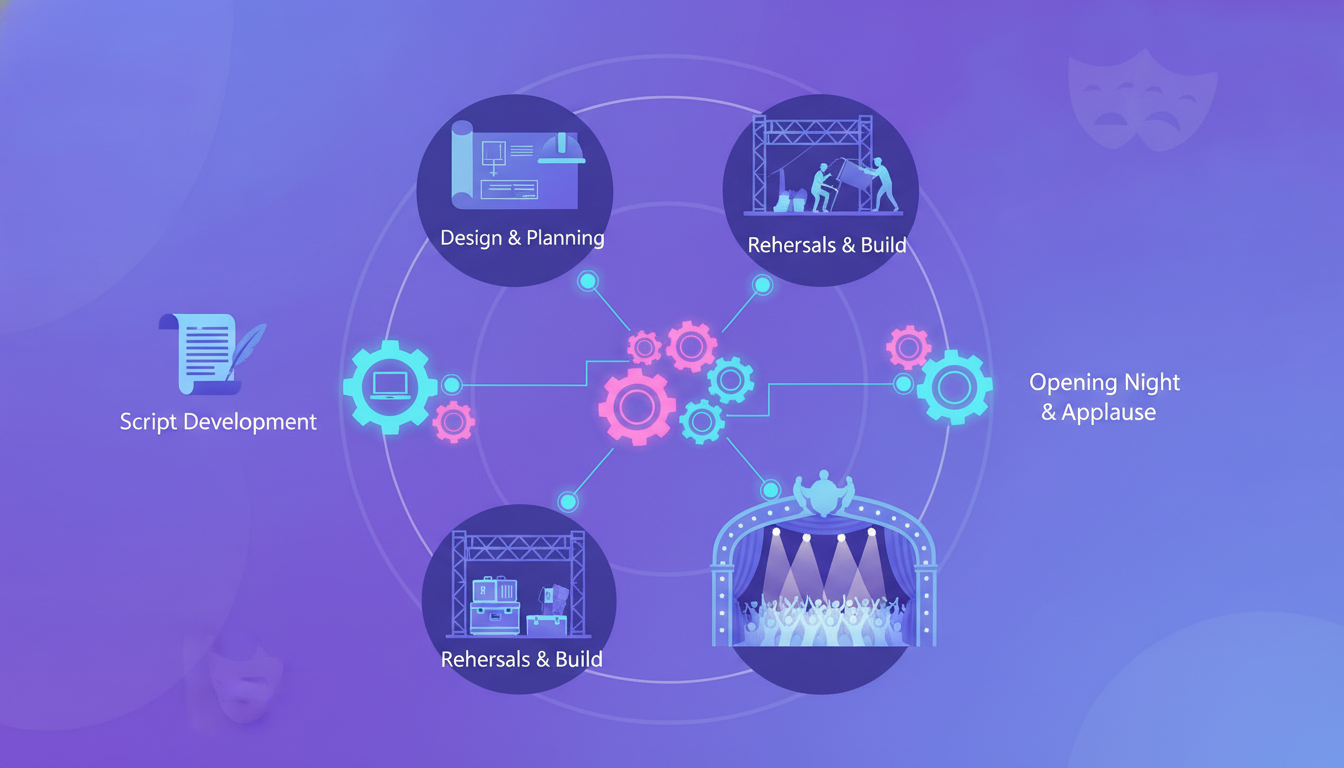
Empower Your Production, Magnify Your Magic
Imagine if you could reclaim hours currently spent on tedious research or complex logistical planning. What would you do with that time? Perhaps you'd spend more one-on-one time with actors, delve deeper into character development, refine a tricky piece of blocking, or simply enjoy a well-deserved evening off. The future of theater production isn't about eliminating the human touch; it's about amplifying it by removing the friction.
Platforms like CueCall are designed with this philosophy at their core, integrating smart, AI-powered tools directly into a comprehensive production management ecosystem. From initial script analysis to streamlining complex schedules and providing creative inspiration, CueCall aims to be that intelligent co-pilot, empowering school and community theater groups to focus on what they do best: creating unforgettable theatrical experiences. It's about providing you with the clarity, efficiency, and creative freedom you need to bring your vision from page to stage, smarter and with less stress. It's time to let technology handle the heavy lifting, so you can focus on the magic.